Wednesday, December 5, 2007

Ballet Folklorico


Music and dancing are a big part of the Mexican culture. This is due, in part, to the fact that many of the states in Mexico have music and dances that are native to the different regions. A dance and the music from Jalisco is very different from a dance from Guerrero.


The Ballet Folklorico is the traditional dance of Mexico. The dances usually tell a story; the music is what you might have heard years ago, and still hear now during fiesta time; the costumes are indicative of the clothing worn by the people in in the past. The dances are a colorful expression of their culture and tradition and the dancing is characterized by a lot of energy and motion!


The Mexican people are proud of their heritage and teach each new generation the stories of their ancestors through the native dance and songs. Little children are anxious to imitate the dancers and mothers make costumes for them to wear at holiday celebrations. Some schools even teach the traditional dance and songs.


There are several Ballet Folklorico groups in Mexico and I have been fortunate to have seen 4 of them perform. I enjoyed the dancers from the University of Guadalajara, the University of Veracruz, The Ballet Folklorico of Oaxaca (which came to Atlanta to perform) and now, this past Sunday night, I saw the Ballet Folklorico group from PV.


The white dresses and white shirts are from the state of Veracruz.


In the dance from Veracruz, the women dance with a lighted candle, or sometimes a glass of water, on their heads. They move about without dropping the candle or spilling the water, moving only their feet and hands. You hold your breath it is so beautiful. This is one of my favorite dances.


The "charro" or cowboy costume and dance is from Jalisco. The women's dresses from Jalisco are the full. ruffled skirts with ribbons. Many of the things you are familiar with, when you think of Mexico, come from the state of Jalisco. The cowboys and rodeos, the beautiful, multi-colored, full dresses of the women, the Mexican Hat Dance and tequila are from the state of Jalisco.


The men bow and dip the ladies, and the women twirl about the senores, and at the end, a "kiss" is hidden from the audience by the big sombrero worn by the men! Aren't they lovely?


This dance with the water jugs is from the state of Sinaloa, I believe.

My friend, Nena, and I went to this performance last Sunday night. It was free---can you believe that? If you ever have an opportunity to see a Ballet Folklorico group dance, you must see it. You will be overwhelmed by the beauty and energy of the dancers and the pulsating rhythms of the music.

Hasta luego.


Saturday, December 1, 2007

Back To Work

After a great week's vacation in Guadalajara, it's back to work I go. I am no longer teaching the second graders in the Colegio. I have a unique opportunity to work with English teachers in a new program in the public schools.

In the public schools in Mexico they start teaching English in the 7th grade; however, this year they began teaching English in kindergartens, 1st and 2nd grades in some of the schools. My friend, Lety, is a superintendent of some of the preschools and she asked me if I would work with her English teachers before I leave Mexico.

I go with the English teacher to her classes, observe her teaching; sometimes I teach a quick lesson; and then the teachers and I meet in the evening and we discuss their pronunciation, strategies for teaching ESL, materials they can use, and anything in particular that they want to work on. I will work with them until time for me to return home.

Below are pictures of some of the classes.


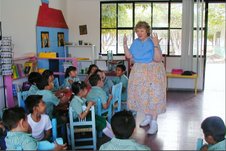
This is a group of 4 year olds listening to a story. They liked the Clifford book.

The preschools are divided into 3 years and are called: Kinder 1 (3 year olds), Kinder 2 (4 year olds), and Kinder 3 (5 year olds). The Kinder 3 is what we call Kindergarten.


These 3 yr olds are singing and playing a game. In the public schools, uniforms are encouraged but not required. Some schools say "blue shorts or pants and a white top". Sometimes they wear an apron over their clothes which they put on over their clothes after they get to school.


Here you see an example of the apron over the white shirt and blue pants. These kindergarten girls got out the book and sang the song to me. It was a chant of sorts and they knew all the words.


Here teacher Magdalena works with a 5 year old on articles of clothing. Magdalena made all the materials for her lesson, and tapes them to the board. She teaches 3 groups of children in 2 schools. There are between 24 and 31 students in each of her classes.

You can see the water jug behind the teacher. Every classroom has a water jug for the children---no water fountains as the tap water is not purified.


These 3 year olds were learning parts of the body. The teacher asked me to help with the lesson.


In the Kinder 2 class of 4 year olds, they were painting "3" objects because they had just learned the number 3. Although it was rather messy, no one played "swordfight" with the paint brushes and after they finished, they washed out the brushes and return the paints to the shelf.


These are 4 of the English teachers at our meeting.

The public school teachers work under unbelievable conditions. There are often 40-50 students in their class. They teach long hours since there are morning classes and afternoon classes. The preschool and kindergarten classes are only 3 hours long but the elementary school classes are 4-5 hours long.

Magdalena, the teacher you see in the photo above, teaches from 9-noon in the two preschools; then she teaches English in the middle school from 2:00-8:30pm. The teachers also have to make all of the materials they use to teach with. There is no copying machine available to them. If they need copies, they have to go to a store and pay for the copies.

I certainly makes me appreciate what I had to work with in the public schools where I taught.

Hasta luego.


Friday, November 30, 2007

Tlaquepaque

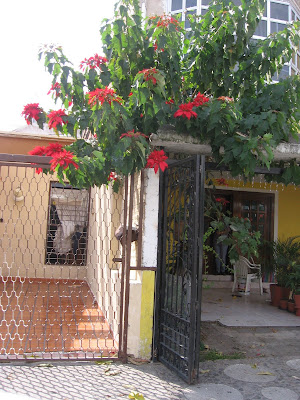
This is a tree growing next to a house in Tlaquepaque. Guess what kind of a tree it is. Can you see the flowers? Look hard at the flowers and remember, it is TREE!


It is a poinsettia TREE! I had never seen a poinsettia tree before. There were quite a few in the Guadalajara area although I have not seen any in PV.

The poinsettia plant is native to Mexico and grows wild. The trees were gorgeous. They are selling many, many poinsettia plants, everywhere in Mexico, for Christmas, just like in the USA but these folks have their own tree in their yard!

As I was taking the picture, the Mexican family who lived there came out of the house, all dressed up, to go somewhere, so we started visiting. I learned they had just moved back to Mexico after living in Chicago for a while! Naturally, we talked a long time---lamenting the fact that we miss Chicago pizza (!), and talking about how beautiful the city is and how much we like Chicago. What a nice surprise! And they gave Rosario a cutting off the tree so she can plant it in her yard.


This is my new boyfriend!! I hope Mr. Neat doesn't get jealous!!

This lady was standing in the door of her shop in downtown Tlaquepaque selling handmade items.


Another option for food! Tortillas on the grill, a big pot of soup or pozole in the back. It all looks good but I must pass up the food being sold at puestos because I am not sure how healthy it would be for me. Food puestos (stalls) are abundant and usually there are people eating at every one of them. It seems to me that the Mexican people eat all the time---but they don't eat much at one time. "Eat little but often" must be their motto!


This photo is very bright and I will have to crop it when I get home, but I want you to see the two women making baskets to sell. The people are constantly making things to sell: weaving baskets, painting ceramics, carving wood, making jewelry. They are very industrious.

Tlaquepaque is a suburb of Guadalajara. (Tla-kay-pah-kay. Isn't that fun to say?) My friend, Rosario, and her family live there. There are 4 major suburbs around Guadalajara that make up the metropolitan area of the city.

Within each city, everywhere in Mexico, there are neighborhoods and each neighborhood, or colonia, has a name which is always used in the address of the home. For example, I live in the "Jardin del Puerto" colonia of Puerto Vallarta.

Guadalajara, the 2nd largest city in Mexico, is the home to several universities, has a wonderful historic area in the downtown, major shopping malls as well as the quaint areas where artisans sell their wares. The weather there is the best! You can get along without air-conditioning in the summer because the temperatures range in the high 70s-80s with a little breeze and low humidity. In the winter, they tell me it is chilly in the mornings and evenings but during the day there are comfortable 70 degree days. For the people living there, wintertime brings out parkas, scarves and mittens but for "us northerners" (ie, anyone living north of Texas!) a light jacket will suffice!

I really enjoy the city of Guadalajara and the people who live there are very hospitable. Planning a vacation to Mexico? I suggest Guadalajara as a number 1 stop on your itinerary!

Hasta luego.

Tonala

Tonala is another suburb of Guadalajara where there are lots of galleries and artisan shops. Every Thursday and Sunday there is a huge flea market there and Rosario and I spent Thursday morning browsing and shopping. I was exhausted after 3 hours of walking and she said we had only covered a small part of the market! Below are some of the puestos with interesting things to buy.


This man is selling sugar cane---a big treat for the Mexican children! He strips the green off the cane, cuts it into 3" pieces, bags it and sells the cane.


This watermelon stand was hard to pass up because it looked so inviting. The Delsey is a package of napkins and the white things next to it are plastic bags. He bags the watermelon, hands you a napkin, and says "Enjoy"! Watermelon is available everywhere in Mexico all the time and it tastes just like our "fourth of July watermelon"----nice and sweet.


This is a homeopathic medicine stand with herbs to cure almost any disease you can think of! The indigenous people, especially, use lots of herbs but I also notice a many homeopathic medicine stores, i.e. natural food stores, in Mexico.


Lots of painted ceramic is available and it is all interesting and pretty. I don't know where they get the actual pieces, but it is all handpainted. I wish I could bring home some of the pottery but it is too heavy and might break in my suitcase, so I must make do with pictures!


More pottery---dishes and in the front is a water jar. The water jars are really beautiful and even though we have safe tap water in the USA, I wish I could lug a water jar home and set it up in the kitchen. They are pieces of art if nothing else! (Don't worry, Mr. Neat, I won't bring home anything that has to be dusted!!)

Since we covered only a small part of the flea market, I guess I will have to make another trip to Tonala some year! Want to go with me?

Hasta luego.


Tuesday, November 27, 2007

Thanksgiving Day---The Mexican Way!

There was no turkey. No cranberries. Not a pumpkin pie in sight! And (sigh) no football on TV to coordinate the dinner with.

A few people did remember that Thursday was Thanksgiving Day in the USA and asked me about it. We celebrated by going to a small restaurant which served typical food from Jalisco (the state I am living in).

Birria is either beef (res) or goat (chiva) meat, cooked and served in a broth with tortillas. All over Jalisco there are Birrierias (places that serve Birria) and each brags that theirs is the best.

I had Birria de Chivo and the tortillas, and I do think it was the best Birria I have eaten.


Rosario's daughter snapped the picture too soon; she is on the phone; but it is a good photo of the table and the food. On my plate is the birria and in the pot behind the napkins is the broth to put over the meat. Tortillas are in the basket in front of me; in the tiny glasses is tequila and sangrita; a bowl of salt; and a tall jar of hot sauce. Rosario is eating a plate of Sole, a thick tortilla with cheese and frijoles that is put under a broiler until light brown. On the far right is a bowl of chile sauce and just out of the photo is the plate of limes.


The kitchen was out in the open, as many kitchens are, and I thought it interesting enough to take a picture. There is a large cooler of soft drinks behind the woman.


I try to be discreet when I take a picture of people but if they notice me with my camera, I always ask if I can take a photo. I wanted this picture of the other part of the kitchen and I asked the ladies if I could take a picture. They said "yes" and immediately began smoothing their hair and the one lady removed her apron and they posed for the picture. Women are the same everywhere!!

Anyway, see the big pot on the stove in the back? And the casseroles next to it. In the front is another stove with a large casserole type pan. Their workspace is very limited, isn't it?

It certainly was a very different way to spend Thanksgiving. I missed my family, of course, and I think we may just to have another special "Thanksgiving" dinner in January when I get back! My grandkids can't do without a turkey drumstick and Z won't forgive me if we don't have a pumpkin pie!

Hasta luego.

Monday, November 26, 2007

Restaurants!

And while on the subject of eating....


Here are a few fun pictures of different restsaurants I visited while on vacation.


At El Patio restaurant in Tlaquepaque (don't you just love that word??!!) the mariachis are women. Mariachis always have certain instruments in their group: violins, trumpets, guitars, and a guitarron. Ocasionally there is a harp. The young lady in the picture playing the trumpet looked to be no more than a teenager.


I know, it looks like a big guitar but it isn't. It is the guitarron--a bass instrument. It is almost bigger than she is but she could play it well.


They even look pretty from the back---with flowers in their hair! The fountain is in the middle of the restaurant and, yes, it is an open air area. This is a very pretty restaurant with good food.


Next is a restaurant that I didn't eat in but I took this photo to show you a typical place where the Mexicans themselves eat.


This is breakfast time in a place in Rosario's neighborhood in Tlaquepaque. This is a typical eating area in an indoor mall that has puestos (stalls) selling goods (clothing, fruit, vegetables, soap, shampoos, whatever,) but there are many different places like this one to eat. Just walk along, see what is being offered, and sit or stand and eat.


Look at the stove in the background and the pots and pans---casseroles, really---that she is using.


Now for the real fun!!


This is the Casa Bariachi, a restaurant in Guadalajara where we went on Friday night. The place is huge, with a stageshow, and look at the giant pinatas hanging from the ceiling! The colored paper is "papel picado" which is actually plastic with intricate designs cut into the paper, and is used inside and outside to decorate. There was a singer, 4 ballet folklorico dancers who danced regional dances, and a 16 person mariachi band! Some good tequila and a great evening with friends listening to Mexican music! What a way to wind up a vacation!


Hasta luego.

Sunday, November 25, 2007

Aguascalientes

Aguascalientes (Hot Waters) is a neighboring state to the north of Jalisco. It is one of the 3 smallest states in Mexico with only 7 cities and the rest of the state is country, small towns and ranchos. It was named because of the abundance of thermal springs in the area.


The capital city, also named Aguascalientes, was founded in 1575 and is a city of about 1 million people. It is an industrial city, and now Nissan has a huge plant there where they make cars. Because of the factory, quite a few Japanese people live in the city.


Originally the city/state was an outpost to keep the Indians at bay but soon provided a link between Mexico City and the silver mines in the state of Zacatecas.


This is the Plaza de la Patria in the centro (downtown) of the city. The Cathedral Basilica of Our Lady of Assumption (Catedral Basilica de Nuestra Senora de la Asuncion) has beautiful paintings from a famous Mexican artist inside. As you can see, there is a large plaza and behind me is the city plaza (the park) and on my left, out of the photo, is the state government building. The history of Aguascalientes is painted in murals on the walls of this building. A student of the Mexican painter Oroszco did the murals.


The picture below is the history museum.


The museum was very small but the people are proud of it! Notice the street has "pavers", (bricks). It is not cobblestone and thus is smooth. A few of the streets in the downtown area had pavers. That is me standing in front of the museum.


After leaving the downtown area, we went to the Jardin de San Marcos. This is where the oldest, (since 1604!) largest and most famous fair in Mexico is held for 3 weeks every year, in April/May. The actual garden has trees, flowers, and a kiosk, but the surrounding area has increased into a plaza where the church is (of course!) and also a large mall area. During the fair there are parades, rodeos, bullfights, cockfights, folkloric dancing, games as well as many cultural events. Of course there is a lot of food being sold! The Mexicans seem to eat all the time!


The picture below is the gate to the garden.


Next you see Rosario standing under the huge "Festival Calaveras" sign which was for the Dia de los Muertos" and behind her begins the mall.


The Calaveras decorations were still up and I am not sure if they remain there year around or not. Anyway, there were a lot of them and they may be part of the city decorations. There was also a big electric sign counting down the weeks, days, hours and minutes until the next fair!


My girlfriend, La Catrina!


Other interesting tidbits about Aguascalientes:

  • The people there are known for their handwork, embroidery and lace making. We went shopping in a store where I could have bought everything! Tablecoths, placemats, napkins, shawls, blouses, everything hand made. Gorgeous handiwork. You will have to see the pretty things I did buy there!

  • It is a very Roman Catholics area and there are a lot of churches. We must have passed at least 4 while walking from the parking garage to the main Plaza Patria and (it being Sunday morning) the churches were overflowing with people.

I was very glad to get to see another area of Mexico, to meet some of the people, and to learn about another state. I appreciate Rosario taking me there.


Hasta luego.