Wednesday, May 7, 2008

Guanajuato

We just had a five-day weekend! Thursday, May 1 was Labor Day, and Monday, May 5 was Cinco de Mayo--another business holiday. I don't know why, but there was no school on Friday, May 2 so everyone who toils in the field of education had a 5 day holiday! That works for me!!

My friend, Lety, planned a cultural tour for us! She wanted to show me the cities of Guanajuato and San Miguel de Allende, as well as some smaller towns, so Wednesday afternoon, after she finished work, we took off, returning to PV on Monday evening. We had a whirlwind trip but at least I was able to spend a few hours in some of the famous places in Mexico. I really enjoyed it.

This story is about the city of Guanajuato, the capital of the state of Guanajuato, which is just north and east of Jalisco. Located high (6,500 ft.) in the mountains, the beautiful, old city with cobblestone streets and houses perched on the side of the mountains, is where, in 1810, Ignacio Allende and Father Hildago entered the city and confronted the Spanish for the first time. The Revolutionary war began.

A tiny bit of history...the Spanish were shored up in the granary which the Mexicans could not reach until Juan Jose de los Reyes Martinez strapped a stone on his back so the bullets couldn't hurt him and made his way to the granary and set it on fire! He is known by his nickname, El Pipila, and there is a huge statue (which you will see below) towering over the city of Guanajuato. A true Mexican hero!

The name "Guanajuato" means "the place of the frogs" and there are several stories, I understand, as to why it was called that. One tale says that the indigenous Indians from the area said the place was only fit for frogs to live! Guanajuato and the surrounding area is famous for silver mines. The Valenciana mine was one of the richest silver mines in the world and at one time much of the world's silver came from it.

The Guanajuato River ran through the city, and a series of tunnels were built to contain the river; however, the river regularly flooded the city. Finally a dam was built on the river and now those tunnels, paved with cobblestones, provide access to the city for cars. There is an "underground city"---a maze of tunnels---allowing cars to traverse the city. Above ground, although there are some streets for cars, most of the "streets" are actually very narrow alleys, allowing for 1 lane of traffic.

Lety's 2 sisters: Rosario, and her husband Manuel, Lupita, me and the dog (!) crowded into their Nissan and made the 4 hour trip from Guadalajara to Guanajuato! We arrived in the city about 7:00PM and after finding a place to stay, Lety, Lupita and I went to see and hear the student musicians play near the University.


Student musicians with medieval instruments, and dressed in medieval costume, stroll the streets in the evening, singing and playing.

The next morning we drove through the city, experiencing the many tunnels, but surfaced and drove through the town to see what we could see from the car. Parking in the downtown area, our main stop was at the city plaza and the Templo de San Diego de Acala.


An artist set up his paintings in front of the San Diego de Acala church.


The main plaza with gardens, benches and a kiosk.


We were fortunate to have an band concert in the kiosk while we were there. The plaza was full of people enjoying the sun (and shade too!) and the music, which could be heard for blocks around the neighborhood.

These boys, wearing a uniform similar to the Boy Scout uniform, were playing a game in the Plaza.

Here I am, standing in front of the Juarez Theater which hosts the International Cervantino Festival, in honor of Cervantes, every October. Artists from all over the world come to present plays, dance, opera, music and art exhibits.

This area is also known as the theater district since there are several theaters located within walking distance of the Plaza.


A pretty street scene.

Another street scene but look high up on the right side of the picture, just above the greenery and see the statue of El Pipila.


Here's a better view of him! The massive stone statue looms high above the city but there is a street leading there and the view of the city is fantastic!


From the statue, looking down onto the city, the clump of green in the middle of the photo is the main Plaza where the band concert was; and across the street, with the red roof, is the church.


Here are a couple of views of the city.


The houses are built on the side of the mountain and cars, driving in off the street, park on the roof of the house! What a garage!

Well, that's the tour of Guanajuato. Later we'll be off to the city of San Miguel de Allende.

Hasta luego.


Cinco de Mayo---An American Celebration

Cinco de Mayo! Americans celebrate with gusto! A time to enjoy a Mexican beer and Mexican food: nachos! A time to celebrate the Mexican Independence---right? WRONG!


The holiday, Cinco de Mayo, is NOT the Mexican Independence Day. That is September 16th and is celebrated enthusiastically by Mexicans all over Mexico.

Cinco de Mayo celebrates the Battle of Puebla. In 1862, some years after Mexico declared its independence from Spain, President Benito Juarez announced that Mexico could not repay its debts to England, Spain and France for 3 years. The French didn't like that and came to Mexico to collect their money!


The French sent an army of 6,000 men to the city of Puebla, with the intention of marching on to Mexico City. They were met by a ragtag army of 5,000 Mestizos and Indians who fought and won the battle in Puebla. Although the victory was short-lived, (the French invaded Puebla again 3 days later, and sent Maximilian to be the emperor of Mexico*) the Mexicans remember the men who fought so hard and lost their lives for their country.


*Maximilian was in power for about 5 years when he lost his backing from the Catholic church and Benito Juarez regained his presidency and Mexico was finally a free country.


So---that is much more than you ever wanted to know about Cinco de Mayo, right?


Regarding the celebrations in Mexico, the people have a day off work, the school children talk about the holiday in school, but as far as big observances go, it is more of a regional holiday, commemorated in Puebla, than nationally. Puebla celebrates with gusto and in Mexico City, President Calderon probably made a speech and there may have been military parades. In Guadalajara and Puerto Vallarta, there were no festivities.

The holiday has been embraced by many Mexicans living in the USA, and in areas around the US/Mexican border.

So go ahead and enjoy those nachos! Have a Corona beer! Play some Mexican music! You will have a great party, and why not? Just don't think that you are celebrating the Mexican Independence Day!

Hasta luego.


Tuesday, May 6, 2008

What Am I Doing Here in Mexico?

You might be wondering just what is it that I do all day! The purpose of my visit this time is to write curriculum for the teachers to use next year in the pre-school and kindergarten English classes.

This is the first year that English has been taught at this level in the public schools in Puerto Vallarta and the supervisors are interested to see how the children are learning and they want additional curriculum for next year. Over 60 teachers are taking classes to learn English so they can teach it in the public schools.

When I arrived here, I went to a preschool/kindergarten where I observed the English teacher and her methods of teaching for about a week. Then for the next two weeks, I taught the classes there and then tested the students individually to see how well they are learning the language. I also tried different teaching strategies to learn what worked the best with the younger language learners. I was at the school from 9:00-12:00 and taught 1 three year old class, 2 four year old classes and 2 five year old classes.

In the afternoon and evenings, I met with 2 teachers and we began the tedious job of writing the curriculum.

I have finished at the school, although I will go back again next week to say goodbye to the children and the teachers. My job there, which was learning which teaching strategies work best with the younger children, has concluded. We know what we can use and what we can't use with the little ones who are learning English.

I continue to write the curriculum at home. Thank goodness for the computer and the Internet! That has been a life-saver for me! With the material available there, we don't have to try to reinvent the wheel! I can use songs, games and chants that I find on the web and that have worked well for other English teachers. The Mexican teachers are not aware of the wonderful world of information for teaching English that can be found on the Internet. They are like kids in a toy store when I show them a new website!

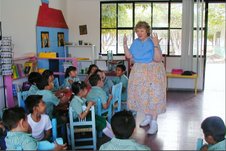
So here are some pictures of me teaching at the school. This first picture is the three year old class.


There are 19 three year old children in this class, including one set of identical twins!


This group of four year olds talk about the letter Aa and the apple! There were no bulletin boards in the classrooms so I used masking tape to hang the pictures on the chalkboard.


"Today is Monday. Yesterday was Sunday. Tomorrow will be Tuesday." Sing it and you can learn it. That's a good way to teach the days of the week!


This little guy gets to be a bee and buzz around the room! The "z" sound in English is difficult for Spanish speaking people to say. So we "buzzed" a lot!


These five year old boys are trying a conversation: "How are you?" "Fine, thanks. And you?"


"Come on, honey, you can say it! I'll help you."

I tested the children in both English and Spanish, asking the same questions in both languages. It was interesting to note that many of them knew the colors in English but not in Spanish! And when I asked, in Spanish, what the name of the color yellow was, about 95% of them replied "yellow" (in English) instead of "amarillo".

I enjoyed being with the children and seeing how they are engaged in learning to speak another language. It would be interesting to see this same group of children in 3 or 4 years to see how well they have learned English.

In the meantime, I continue to write the curriculum and hope that my help will ease the burden of teaching English for the new teachers next year by giving them some new ideas and methods of teaching. The supervisor says I must continue to help when I get back to Georgia and then come back on the fall! (Don't worry, Mr. Neat. That's NOT going to happen!!)

So that is what I do everyday, here in the land of sun and fun!

Hasta luego.


Las Flores de Mexico

These are pictures of some of the beautiful and different flowers in Mexico. Enjoy!


This is the Rosa Morada tree.


A close-up of the Rosa Morada tree.


Same close-up. Sorry, I made a mistake and don't know how to delete, so enjoy the same picture again!


Palm trees silhouetted against the blue sky.


A blooming cactus.


This is a Primavera tree in Guadalajara with gorgeous, orange blooms.


A Maguey plant---also known as the Blue Agave. The Agave is where we get that great tequila!


Bougainvillea in San Sebastian.


I love to see the different flowers, trees and landscaping here in Mexico. I wish I could take a picture of everything!!

Hasta luego.

Thursday, April 24, 2008

Get Ready to Say: Awww!

What am I doing in PV this time? I have been very busy teaching and working.

My friend, who is the supervisor of one of the preschool zones in Vallarta, has started a new program this year of teaching English in preschools, kindergartens, 1st and 2nd grades in her school zone. During the fall, while working in this program, I went into the classroom and observed the English teachers during their classtime and later helped them with pronunciation and strategies for teaching English as a Second Language.

When I returned home in December, I continued to answer questions for them and send information to them via the computer.

Lety asked me to return to Vallarta this spring to see how the program is progressing and help write an addition to the English curriculum for next year.

In the afternoon and evenings, Lety, another teacher and I are working on developing the new curriculum. In the mornings, I have been going to a preschool from 9:00-12:00, teaching 3, 4 and 5 year olds. They have been learning English all year and my job is to assess how well they are doing as well as to try out some of the new ideas in the classroom.

This is my first time teaching preschoolers and kindergartners and I have renewed respect for those teachers! The little wiggle-worms are precious, but oh, do they keep you on your toes!

The Estancia Decroly Preescolar is a small, private preschool and kindergarten. There is one class of 3 year olds, two classes of 4 year olds, and two classes of 5 year olds, and also a day-care room with about 10 toddlers.

This is class 2A and they are 4 year olds. Today there were only 11 students present but usually there are 16 in the class.


I am still learning names but Rivaldo, the little curly headed boy on the floor is "my helper"!


Lucero, the teacher in class 2B, also 4 year olds, speaks a fair amount of English and is a good support for Erika, the English teacher. All 15 students were present today for the picture. This is my favorite class!


Class 3A is kindergarten age: 5 year olds. Nallely, the teacher, has her hands full with 20 children and several who are "special ed" students. Nallely lives near me and picks me up in the morning for a ride to school.

Monica, the other kindergarten teacher, has 19 students in her class 3B. They like to "surprise" me each day when I come into their class. They are seated with their heads down on the table and when I enter the room, they shout "surprise"! Great fun!

The classrooms in this school are very small and I think 10 would be a manageable class size for the teaching area. The teachers have to move the tables and chairs for each new activity. The floors, of course, are tile, and the walls, cement, so the noise level is quite loud.

And here is class 1A, the 3 year olds with teacher, Hilda. She has 18 in her room. I couldn't get all the children in one picture so there are 2 photos of them. Just look at those faces! Aren't they cute?

With the exception of your own children and grandkids, aren't these the sweetest faces you have ever seen? I love the hugs I get every morning as they arrive at school.


And here is my favorite student!!! 6 months old and the happiest baby I have ever seen. I call him "Smiley" because he breaks into a big smile every time I see him! He is the son of one of the cooks and he comes to school with her and has a wonderful time watching the kids play.

I am enjoying the teaching experience, the children as well as the writing. It is a challenge to write curriculum, including strategies and materials for the Mexican teachers, because they have such limited resources. We have to be very creative when suggesting ways to teach an English lesson. Worksheets are out because the teachers do not have access to copying machines. Some teachers have a CD player and can use music CDs in the classroom. Almost all materials are hand-made by the teachers. Not many can afford to buy posters to use in the classroom. It is quite different than many schools in the USA.

The important thing is that the children are learning English. They have good accents and are not afraid to try to say those "strange words". The younger the better for learning a second language.

Hasta luego.

Monday, April 21, 2008

Won't You Come In?

You have seen the outside of my house and now I am inviting you inside...

As you enter the front door, you are in the dining room. She has a breakfront and table and chairs there and I hope you can see the fresh fruit bowl on the table. A papaya, cantaloupe, bananas, apples, mangoes, avocados, guayabas and limes greet you with their wonderful aroma as you enter the house . Today there is a jicama on top too.


The living room is just beyond the dining room past the railing.


On the other side of the dining room is the kitchen with the pass-through.


The living room has a sofa, loveseat and a big comfy chair. The little TV tray hold our computers. The Internet is hooked up there.


Here is the other side of the living room. The stairs lead up to a family room, 2 more bedrooms and 2 baths.

From the second floor, there is a set of stairs to go up on the roof where there is a lovely, tiled terrazzo, the boiler for the hot water and her washing machine. If a family has a washing machine, it is usually outside, covered with a plastic material to protect it from the weather.

You can see my bedroom next to the stairs.


This is my bedroom. The bed is wooden, very sturdy, and the mattress sits directly on the bedstead---no springs---but it is very comfortable. Lety put one of her dining room chairs and a TV tray there for me to use. My suitcase stands in the corner and holds my blanket (which I have used every night so far!) It is very convenient to have the TV tray to hold my clock, glasses and journal.

The windows are sliding doors which open out onto the back patio which is surrounded with a 10' wall---a very private area.


On the other wall is my closet and the door leading out to the living room.


When houses are built, there is usually no built in closet. This wooden closet is installed separately and there are roomy drawers to hold my "stuff"! The bedroom door swings closed so i use my sandals as a doorstop! (Any better suggestions for a doorstop?!!)

On the subject of closets, the master bedroom, upstairs, has a huge walk-in closet as well as a huge bath, complete with jacuzzi tub and a large shower.


This full bath is accessible from my room as well as from the living room. (Note the water bottle for brushing teeth!)


The shower is larger than mine at home! It is a nice bathroom.


Back to the front of the house and the kitchen. All stoves are gas which is supplied by a tank which one buys when the old one empties---and you never know when that will happen! This morning Lety was cooking and the flame went out: no more gas! The gas man will be around tomorrow.

Don't know if you can see it or not, but next to the stove in the front is a spoon holder and a small bottle with a white cap which is Microdyn. We wash our fruit and vegetables and then submerge them is a bowl of water to which 2 drops of Microdyn is added to clean them for eating. Any fruit or vegetable which will not be peeled is put in Microdyn.


Next to the fridge are 2 small pantries. Be careful or you will hit your head as you duck to go in! But they hold a lot. Lety stores lots of her school supplies there as well as food.

As you can see, she doesn't have much furniture yet as she has only lived in this house about one year. She is saving to buy furniture, but first, she says, she needs to finish paying for the house. The Mexican people don't have mortgages like we are used to having and thus they must save their money to finish building their house, to add on to their house (such as closets) or to buy furniture. She does have a couple extra mattresses and a couple blow-up mattresses upstairs which she willingly pulls out for extra guests! She has made me feel very much at home here.

I am having a different living experience this time while I am in PV. My home in the fall was with the hard-working, lower, middle class and now this encounter offers me a contrast. I highly value both exposures.

Hasta luego.